
.svg)

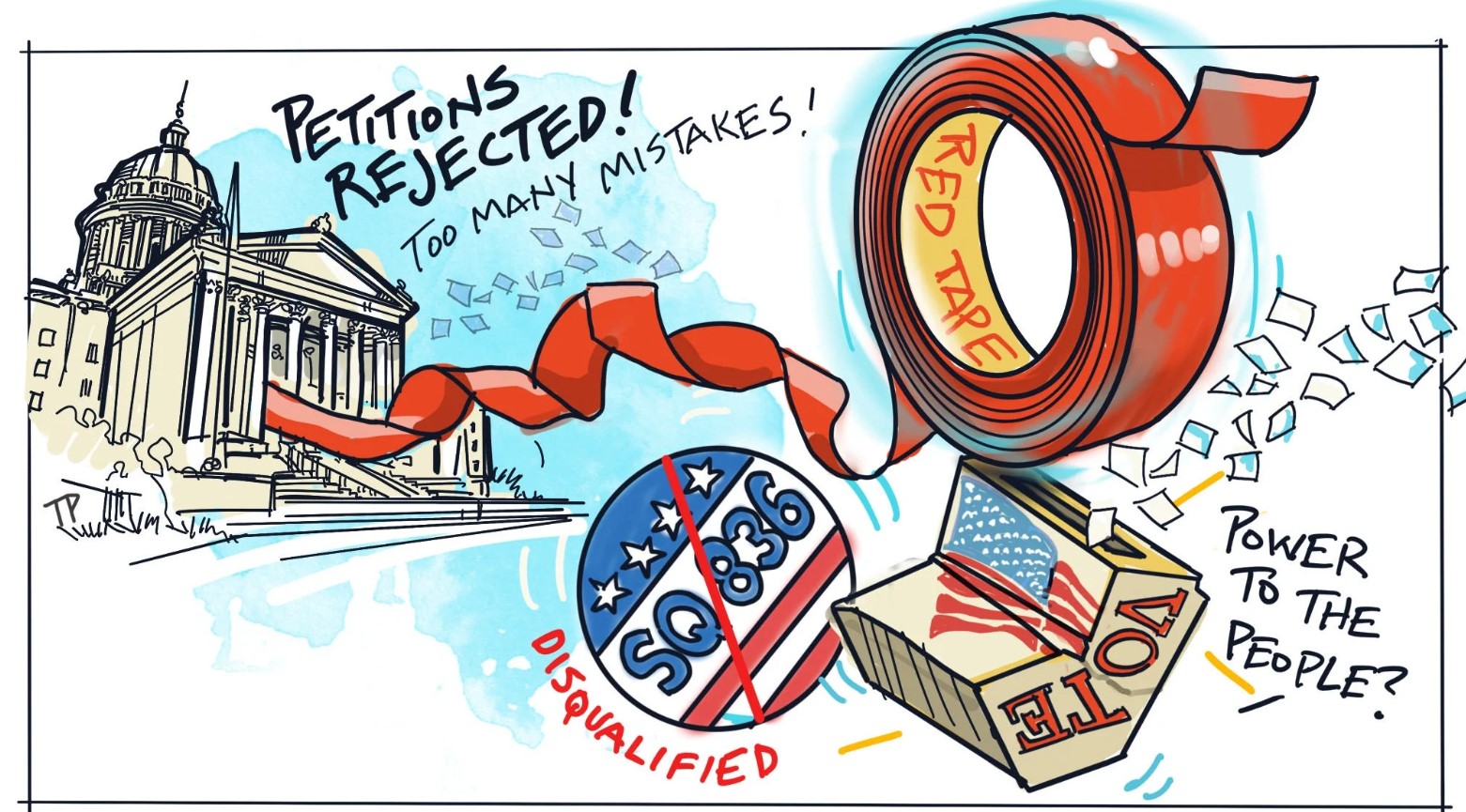
Sometimes the smallest details can kill a project. That's the case with the petition gathering for State Question 836.
Before verification could even start, 205 pages (each with nine possible petition signers) were eliminated because of incomplete petition gatherer information in the affidavit, such as missing notary signature, date of notary, or incomplete address -- all information that could have been corrected before submission. SQ836 did have the lowest number of disqualified sheets in comparison to the last two initiative petitions but, nonetheless, meant a removal of potential signatures. SQ832 had 781 disqualified out of 18,660 submitted sheets and SQ820 had 1,181 disqualified sheets out of 23,043 submitted.
Out of the 26,788 sheets submitted by SQ836, a new high since the new verification system began five years ago, only 209,616 lines had data to verify which is 7.8 lines per nine-line page, meaning nearly two lines -- on average -- were blank or marked-through on every page. Some pages only had one line of data to verify, so a lot of effort went into notarizing the page for only one possible signer verification. A mistake of lost opportunity.
An amazing 1,746 failed to collect a date of signing the petition but all other data was collected. State law requires the date of signing to be collected along with the signer’s data points. These could have easily been added by the signer at the time of the gathering if the petition gatherer had only brought it to the attention of the signer.
Just over a thousand lived outside of the state of Oklahoma and, while these would not have counted anyway, the signature gatherer took time to collect their information and take up a line on a sheet for no reason. This is also problematic for the proponents since they might be counting these when trying to determine the whole number collected.
Another mistake is duplicate signers which, again, is wasted time and effort, takes up a line that could have been used by another verified signer, and may throw the proponents off in their total tally. The first signed line is verified, and all subsequent duplicate lines are not accepted. Had signature gatherers asked whether the prospective signer had already signed it before letting them sign again could have eliminated this mistake.
Two other small errors: 163 signed the petition outside of the designated circulation period and 516 were not registered to vote at the time they signed the petition.
All of these are mistakes that mount on each other to a point where achieving the desired amount becomes more and more difficult.
Keep in mind the FOUR data points out of FIVE for verification gives proponents a 20 percent error rate in their petition gathering, which is already a huge advantage considering the challenge of collecting the data in the first place.
Consideration is also given to those signers who may provide all of the information but didn't follow the instructions. For example, signers are allowed to print their last name first and then their first name instead of first name and then last; if the house number is printed in the "rest of address" box but not the designated house number area, and any of the boxes that are marked through and written around that area.
Success is obtainable, but proponents will need to reduce the clerical errors, improve collection efficiencies, and prevent more of the simple human mistakes.
The Secretary of State and its vendors, including Western Petition Systems, are working as hard as we can to verify every signer, but these aforementioned mistakes just cannot be overcome.
Cartoon by Todd Pendleton, The Oklahoman